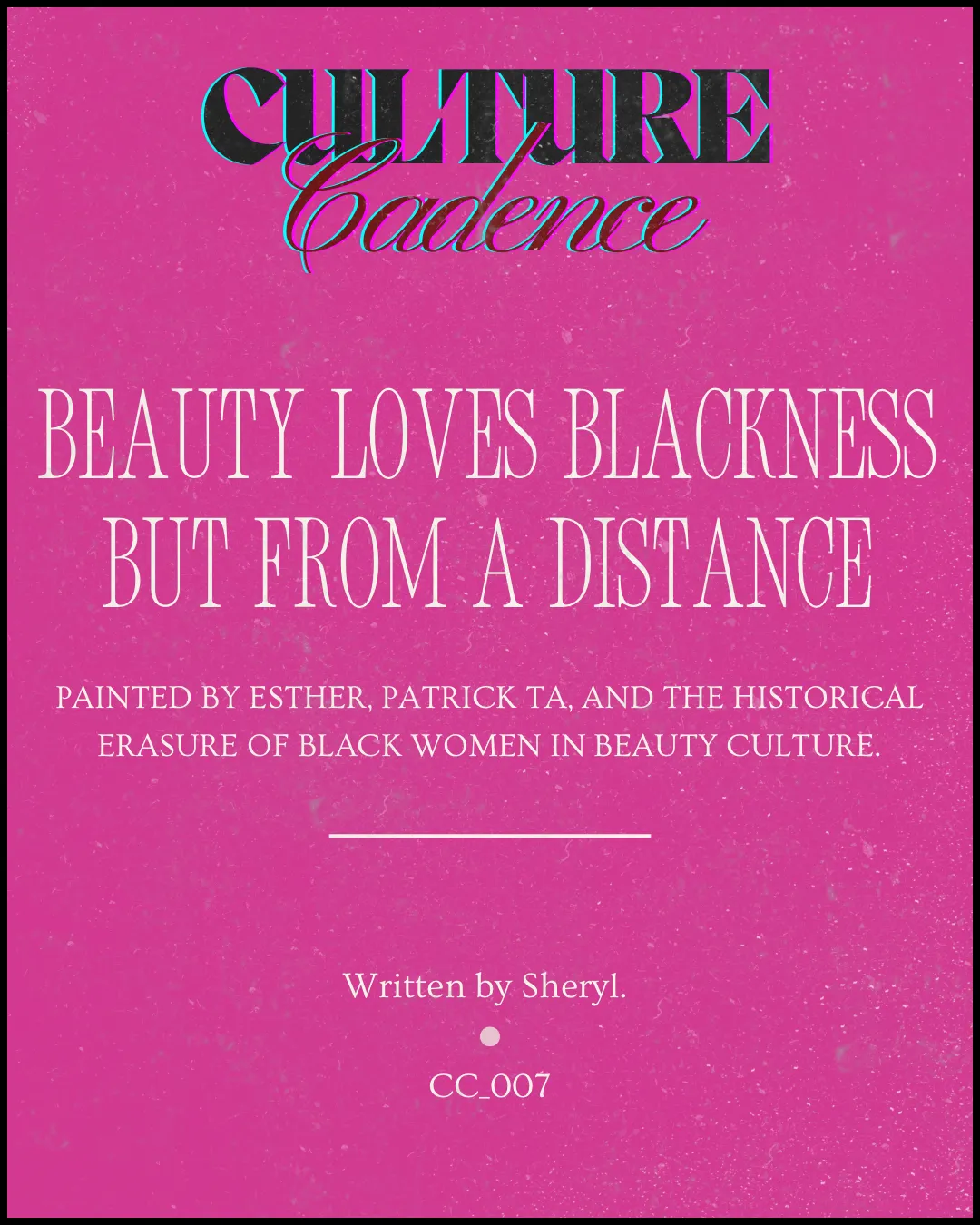
What can look like a beauty disagreement on the surface can often reveal what is actually a very familiar cultural pattern. The recent controversy between Nigerian – British makeup artist, Painted By Esther, and beauty mogul, Patrick Ta is a perfect example of how black women often shape aesthetic language, only to watch it become more commercially valuable elsewhere.
On May 27th 2026, Patrick Ta launched a line of beauty products under the trademarked title of “transition blush”. He describes this blush as a ‘breakthrough category designed for a forgotten area’. However, as soon as this launch hit the internet, it was met with a massive wave of backlash, with uproar that mostly came from black women within the beauty community. The backlash Patrick Ta has been facing for the past week has been linked to Painted By Esther and her popularisation of the transition blush technique within the past year.

Esther has made a name for herself through her viral looks created for celebrities, cultural figures and black female icons such Viola Davis, Kelly Rowland and Naomi Campbell and many more. What made Esther’s looks stand out in particular was how she popularised the use of pink blush on deep skin tones, going against one of the beauty industry’s most persistent myths – that pink blush doesn’t belong on black skin.
Now with that being said, Patrick Ta trademarking the term “transition blush” is quite insidious because whether intentionally or unintentionally, that technique is now directly tied to his name and his brand. This prevents other make-up artists and beauty creators from using this term for their own work without inadvertently crediting him, negatively impacting artists like Esther.
However, neither Patrick Ta nor Painted By Esther have claimed to invent this transition blush technique. Esther specifically refers to the actress Devon Aoki as one of her major inspirations for this style of makeup. So ownership of this technique is not where the friction and controversy is coming from. The real tension is how black women’s influence and impact is repeatedly absorbed into mainstream beauty culture without equivalent credit, protection or reward
This pattern extends way beyond blush. Historically, black women have been treated as the testing ground, the source material and the aesthetic engine for trends that become palatable once repackaged. Black beauty markers such as laid edges, long acrylic nails and darker lip liner have often been treated as tacky, excessive or unserious when worn on black women. Despite this, there have been many occasions in which these aesthetics are then reintroduced as trends, luxury or editorial beauty by white women.
One of the clearest examples came in 2016 when Kim Kardashian introduced “boxer braids” in 2016 – a repackaged version of box braids. A more recent example was Hailey Bieber introducing “brownie glazed lips” in 2022 – the same lip liner technique black women have been using for decades. While these women faced a lot of backlash from black women online, they also received a wave of excitement and hype from white mainstream media – showing the hypocrisy and double standards black women experience in the beauty world.
Another clear example of this hypocrisy can be seen through the rise of surgery culture particularly around lip fillers and BBLs, with the Kardashians often treated as the pioneers of a look long associated with black women. Full lips and full figures are and always have been heavily associated with black femininity. However, throughout history there have been several records of these features being demonised, hyper-sexualised and used as a tool of humiliation, with Sarah Baartman being one of the most infamous demonstrations of this.
To clarify, black women did not invent lip fillers or BBLs (clearly), but the mainstream pursuit of fuller lips, fuller hips and a curvier silhouette did not emerge in a cultural vacuum. Features that have been discriminated against on black women became glamorous and desirable once reproduced elsewhere.
When black beauty elements are repackaged, perception changes because they become depoliticised and associated with whiteness and the eurocentric beauty ideal. But most importantly, the rebranding of all these things – box braids, lip liner, full lips, curvy bodies – becomes attached to people with more mainstream protection.
This is why credit is so important. It is not just about giving people a shoutout or a tag in an Instagram caption. It shapes who gets paid, remembered, legitimised and treated as an innovatorrather than just an aesthetic reference point. Beauty culture thrives on borrowing and there is nothing wrong with that, but not all borrowing is equal. The industry often wants the look, the texture, the attitude and the cultural energy black women bring naturally without fully embracing the women who made those things meaningful in the first place.
Beauty makes it very clear that it loves blackness. But too often, it only loves blackness once it has been filtered and made safe enough for mainstream consumption. Black women have always been influential. But it seems that our influence is easier to celebrate than we are.