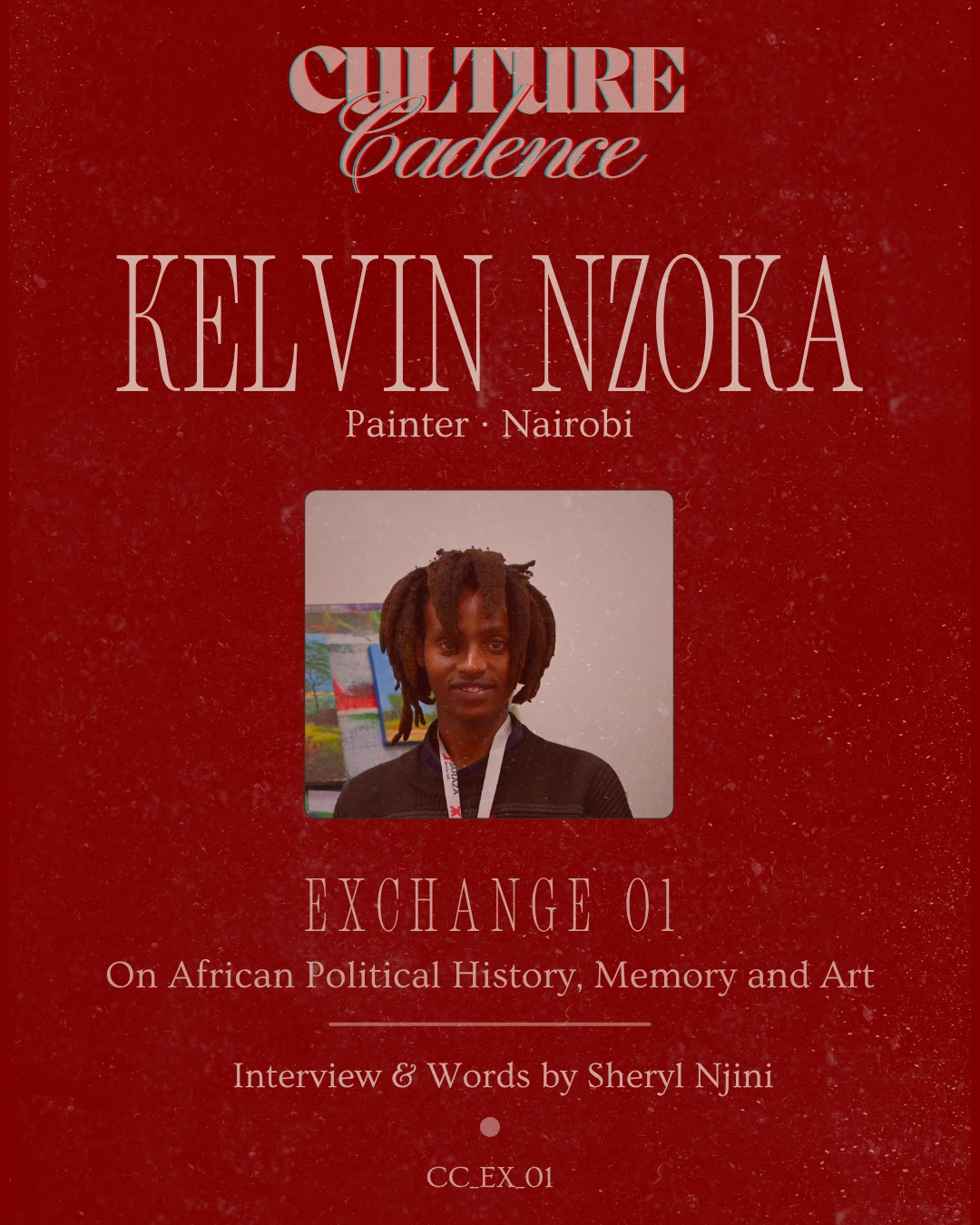
Based at Mukuru Arts Collective in Nairobi, Kelvin Nzoka is a painter whose work explores African political history and the systems of violence surrounding colonialism, liberation and statehood. Through research-led paintings, he examines the histories and ideologies that continue to shape the continent.
We met Kelvin during a cultural exchange with Mukuru Arts Collective in Nairobi. In the first edition of our Q+A series, he speaks about discovering art as a viable career, researching the Mau Mau uprising and tracing the AK-47 through Soviet influence, African liberation movements and neocolonialism.
You’re now part of Mukuru Arts Collective in Nairobi, but where did your own journey as an artist begin?
“Where I come from, art was not really seen as something you could pursue as a career. I mainly drew portraits on paper, and I didn’t know that art could be a way of making a living. I was already an artist, although what art meant to me was very different then.
Joining Mukuru Arts Collective introduced me to different art forms and communities. I began meeting other artists, using platforms like Instagram and learning much more about the art world. Before that, my understanding of art was very limited. Now, I wouldn’t categorise myself only as a portrait artist; I would describe myself as a painter.”

Your work is deeply inspired by African political history. Which events, figures or ideas are you most drawn to, and why?
“My interest began when I was researching the Mau Mau uprising. I wouldn’t describe myself as a very political person, but through that research I became interested in the dynamics of politics. I wanted to understand the different perspectives surrounding the uprising, including the settler’s perspective and the native perspective. They present two very different ideas.
The settler’s perspective tends to emphasise the supposed economic progress of the colonial project, while the other perspective reveals its oppressive effects and how colonialism changed people’s understanding of themselves.”
When you begin a historically inspired piece, how do you translate that history into a visual language through colour, symbolism and materials?
“It can be difficult for me to translate the research onto the canvas. My work is quite detached from emotionality because I am trying to make statements through it. When looking at history, I am trying to develop an understanding of what transpired and then find a different way to present that through the painting.
I want each artwork to be independent and able to exist by itself. I don’t want somebody to need lots of supporting documents before they can engage with it.”
Is there one artwork of yours that particularly captures the relationship between art and political history? What is the story behind it?
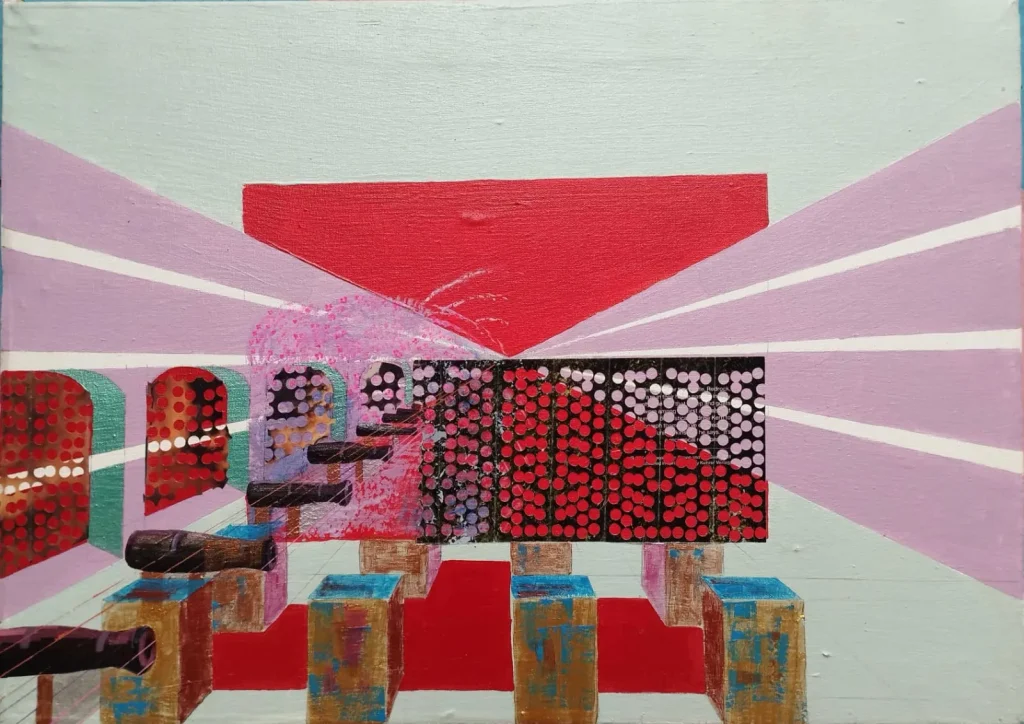
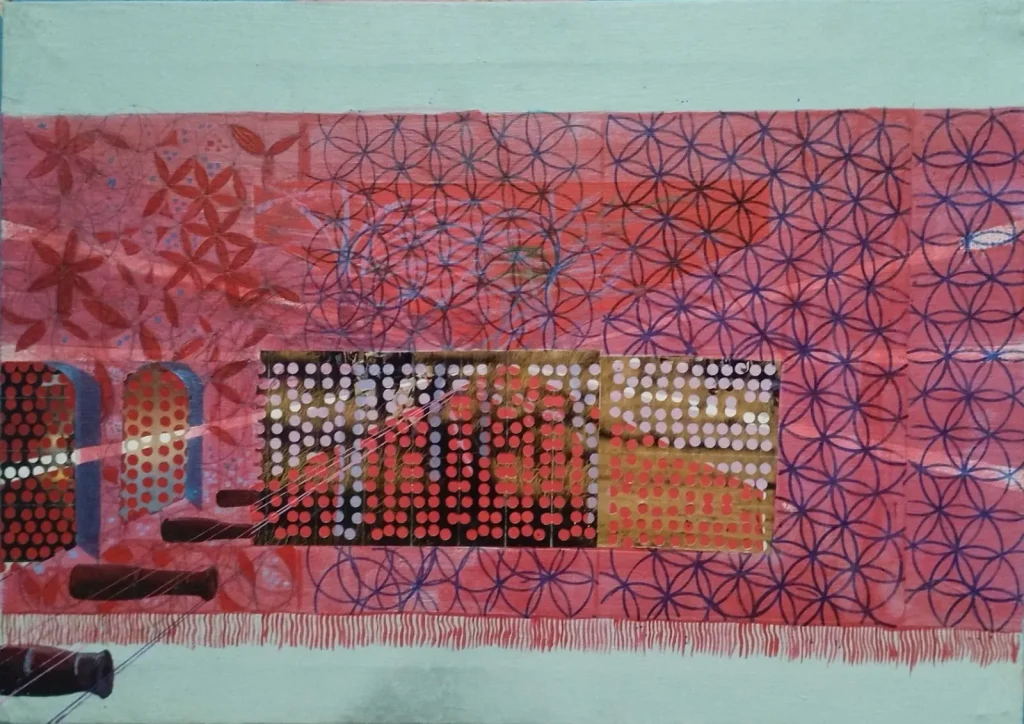
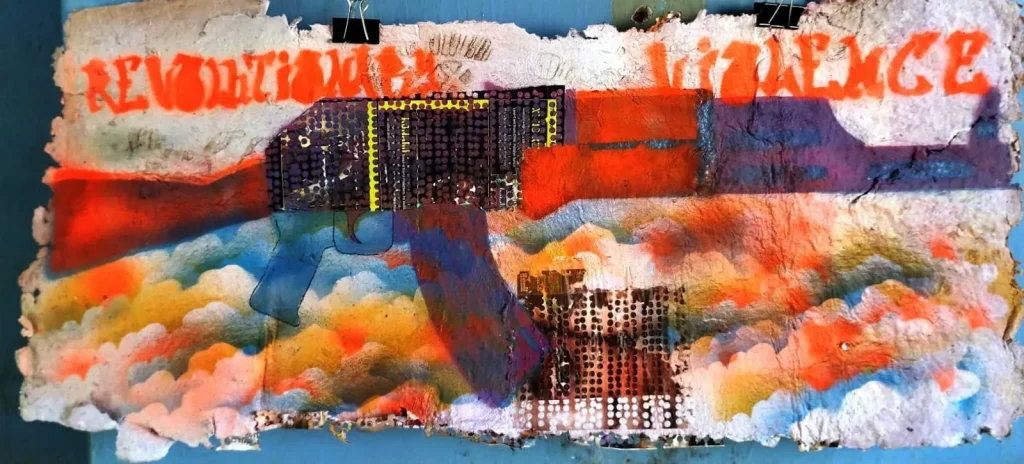
“A recent project I have been working on looks at the history of the AK-47. I became interested in the gun itself and the political history surrounding it. My research led me to its relationship with the Soviet Union, the Comintern and the distribution of weapons to African anti-colonial insurgencies.
During the Cold War, the Soviet Union supported liberation movements by supplying weapons, but it also used that support to spread communist ideology and create Soviet-aligned states in Africa. This made me question whether these movements were shaped by genuinely Pan-African ideologies or by the interests of another global power.
Violence was necessary for many African countries to gain freedom, but that freedom did not always produce complete sovereignty. In some cases, colonial rule was followed by another form of external influence or neocolonialism. Countries such as Angola became sites of proxy conflict, with African liberation struggles caught between the Eastern and Western blocs.
I have also been reading Hannah Arendt’s On Violence, which has changed how I understand the subject. Violence has become one of the central threads running through the story I am trying to tell.”

African political history has often been recorded through colonial or external perspectives. What can artists recover, challenge or preserve that conventional historical accounts cannot?
“I think the role of art is to create awareness about what is happening in society. Art can sometimes feel elitist because of the language and terminology artists use when expressing themselves. What I am trying to do is digest these larger systems and present them in a more simplified form that people can understand and have conversations around.
Trying to understand an entire history can be difficult, especially when it is shaped by Western ideologies and terminology. Through my art, I want to make those histories easier to engage with and create space for people to question them.”
How have Mukuru Arts Collective and the wider community around you in Nairobi shaped your artistic practice?
“Joining the collective opened my mind because it gave me access to a wider artistic community. When you become part of an existing community, you learn how to express yourself and become a better version of yourself because everyone is encouraging you to be yourself.
Being here has pushed my limits. From the outside, it can be easy to place artists into one category, but once you enter these spaces, you discover a whole range of people discussing different subjects and finding different ways to express themselves. Seeing that diversity, alongside the conversations we have at the collective, continues to push me every day.”
When someone encounters your work, what do you hope remains with them—and which histories or ideas are you interested in exploring next?
“When somebody encounters my work for the first time, it may be difficult for them to immediately understand what is happening. What matters to me comes after I have had a conversation with them. Once I explain what I am trying to do, I want to hear what they think about the same subject—not only the execution of the artwork, but the ideas behind it. I want them to bring their own perspective to the painting.
The work is not only about its physical appearance. I want it to create awareness and encourage conversations about where we are in the present moment. I don’t necessarily want my work to speak towards a particular future because I think that would be unfair; I prefer it to remain grounded in the present.
At the moment, I am continuing to explore violence because it is the main thread within the history I am trying to tell. I’m interested in understanding how different historical and political ideas connect and how they have shaped the situations many African countries find themselves in today. I want to continue making work about Africa, while also questioning whether “Africa” can be understood without looking at the Western policies and external forces that have shaped it.”